
Beyond Wine: Discovering Cafayate’s Andean Table

In this interview, Terri Casey (www.caseyargentina.com) speaks with Diane Romero, who shares her journey through Northwest Argentina and explains why the Calchaquí Valley is emerging as one of the country’s most compelling culinary destinations.
Diane Romero is a cultural storyteller, creator, and co-founder of The Andean Table, a bilingual cookbook that celebrates the food, people, and ancestral traditions of Northwest Argentina. Based between cultures, she bridges heritage and modern life through storytelling, food, and design. Diane is also the creative force behind Urban Andino, a lifestyle brand honoring Andean craftsmanship, natural bounty, and ritual.
Deeply inspired by family, community, and place, her work preserves living traditions while inviting the world to experience the soul of NW Argentina—one table, story, and shared moment at a time.

What was your personal journey that brought you, a North American living in Argentina, to become so enamored with this region in NW Argentina, that you wrote a cook book about it?
I came to NW Argentina for love and work, developing La Estancia de Cafayate - a wine and golf resort in Cafayate which exposed me to many facets. The people are what most struck me - they live with another version of time. These people are the ones who preserve our traditions that have become lost or dimmed over time. I wanted to celebrate these people and their connection to the beautiful and bountiful lands in which we are graced to live. And the concept of food and abundance of healthy core ingredients which are native to the region and recipes as a place that shares the culture.
I came from a publishing background, so to be able to publish a book just made natural sense. This region is remarkable and needs to be shared with the world.
The Calchaquí Valley is well known as a wine destination. But what about the food? Why doesn't the world know about it yet? Is that about to change?
The valley built its international reputation almost entirely on Torrontés and high-altitude Malbec, and that's not an accident — wine travels and photographs well, and fits neatly into a global category. Food is harder to export in the same way: it's regional, it's home-cooked as much as restaurant-cooked, and until recently there wasn't an English-language document making the case for it. That's the gap The Andean Table was written to fill. Whether it's "about to change" is really a question about young chefs, agro-tourism, and visibility. I can say that the biodiversity we boast here is like no other. From the high altitude punas, to the tropic of the rich yungas - this place has an amazing array of satisfying and super ingredients.
What is Andean cuisine and what are some of the unique Ingredients and dishes that are staples in a local kitchen?
The local cuisine of Argentina's Andean Northwest — Salta, Jujuy, mainly— is shaped by the region’s high altitude and pre-Columbian Andean staples layered with Spanish colonial and criollo influence. It's built on corn, squash, beans, native tubers (Andean potatoes), and goat meat, cooked low and slow.
Staples include:
Locro
The anchor stew of the region: corn, beans, squash, and meat simmered for hours; the closest thing we have to a national dish.
Humita
Fresh corn, onion, and cheese wrapped and steamed in the corn husk itself.
Quinoa
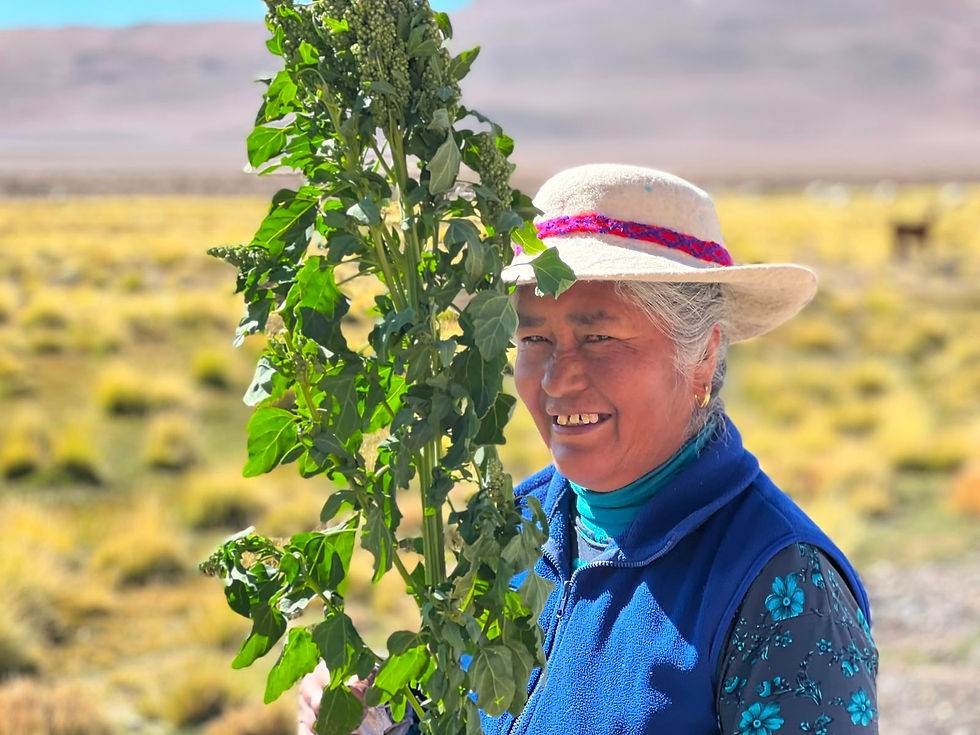
In its original high-altitude Puna context, it's a subsistence grain grown at 3,000+ meters, not the Western "superfood" — used in soups and as a grain side, sacred to Andean agriculture long before Incan times.
Maíz
Capia and coya corn varieties are the true staples.
Ají
Regional chili varieties, dried and ground, form the backbone of seasoning - Ají Molido (ground chili peppers)
Why do the peppers, oregano, and pimentón from this valley taste different from anything you find in a North American supermarket? What makes a spice "single-origin"?
Three things: altitude, intense UV exposure, and mineral-rich, low-water desert soil. Plants under stress at 1,700+ meters concentrate more essential oils and capsaicin/capsicum than the same varieties grown at sea level in high-irrigation farmland — which is exactly how most commercial pimentón and oregano are grown. "Single-origin" for a spice means the same thing it means for coffee or chocolate: everything comes from one specific place, grown, harvested, and processed as a defined batch, rather than blended from multiple countries or regions the way most supermarket spice jars are - which is standard industry practice, and legal, but it flattens out exactly the terroir differences that make a spice interesting.

What do locals eat at home on a regular Tuesday?
A regular Tuesday at home here is really about genuine time at the table — the art of gathering is central to how locals live, not an occasion, just daily life. In cooler months, a carbonada — a hearty vegetable stew — is a common weeknight meal. And empanadas are the true staple, showing up on tables in some form almost any night of the week.
You are organizing a culinary tour of Cafayate. Tell us a little about that event.
Through a series of strange coincidences, I reconnected with an old friend who shares the same passions — she's a chef and owns a cooking school in the US, among other ventures. She asked me to craft an itinerary through Northwest Argentina for her. I'll be sharing the gems of the Calchaqui Valleys that go beyond the cuisine — the landscapes, the crafts, the music, the ancestral traditions, and above all, its treasured people. They'll experience the region the way I've come to know it over the years — through the markets and with the people who keep these traditions alive.
Do you see Cafayate and the Calchaqui Valle as the next big culinary destination?
Yes, without question — and I think we're right at the inflection point that makes it real, not just aspirational. The landscape set the scene first. With more than 300 days of sun a year and a dry, mild climate, this region offers exactly the kind of comfortable, sensory environment that travel luxury depends on. Then wine built the international reputation and also the infrastructure and the audience, and that naturally creates an appetite for food tourism. That's exactly the gap that inspired me. The food culture here is genuine, ancestral, and still largely undocumented for an international audience. It's much deeper than farm-to-table — it's a living connection to the land, and it's never really been framed that way. This destination is primed for a sensory, terroir-driven experience that touches every sense, not just the palate. And there are already incredible chefs across the region doing exactly this work — quietly shaping Northwest Argentina's culinary identity for the next decade.

If you would like more information on options to participate in living life in such a special place as Cafayate, please contact me. With confidentiality and confidence we can assist you to find the right fit for you to enjoy this wonderful place and invest in the bright future there.
Email: caseyteresita1@gmail.com • Tel: +54 9 11 4145 6640 WhatsApp: +54 9 11 4145 6640 • Skype: tcaseyskype or +1 650 206 - 2550


Comments